Friday, March 14, 2014

Overcoming All Obstacles: The Women of the Académie Julian

A Book Review by Stephanie Deshpande

Overcoming All Obstacles: The Women of the Académie Julian by Gabriel P. Weisberg and Jane R. Becker describes the challenges women faced getting the equivalent art education as men in the late nineteenth century. During that time, the Ecole des Beaux-Arts was the most prestigious art institution in Europe, but it did not accept women into its program until 1897. The Académie Julian, which was established in 1868 by Rodolphe Julian, served a unique purpose, to train women in the same academic fashion as men and to prepare them for entrance into the Ecole des Beaux-Arts.

    The women studying at the Académie Julian drew from nude models and studied under the most renowned instructors such as William Bouguereau, Henri Royer, Tony Jean-Paul Laurens, and Jules Lefebvre. Julian’s mission was to establish a good reputation for his students who would in turn generate a good reputation for his school. Cash prizes were awarded in order to encourage competition between students, and some of his best student’s works were entered into competitions under fictitious names, and received rave reviews.  


Maria Bashkirtseff, In the Studio, 1881
(image courtesy of the Art Renewal Center)


 One of Julian’s creative ideas was to encourage Bashkirtseff and another student to paint a scene of the studio. Bashirtseff describes her reaction to Julian's proposal in a journal entry: “'As for the subject, it does not fascinate me, but it may be very amusing; and then Julian is so taken with it, and so convinced. He quoted so many examples which had been successful. A woman’s studio had never been painted. Besides, as it would be an advertisement for him, he would do all in the world to give me the wonderful notoriety he speaks about.’ Not only would both works serve as advertisement for the crafty Julian, but Bashkirtseff’s contribution, in particular, would highlight the high society of the Julian Academy’s students.”(Becker 1999:105)

    There were numerous successful women artists who excelled there; of them were Cecilia Beaux, Elizabeth Gardner, Marie Bashkirtseff, Louise Breslau, Anna Bilinska-Bohdanowicz, Rose-Marie Guillaume, and Anna Klumpke.


In the Woods by Elizabeth Gardner 

(image courtesy of the Art Renewal Center)

What makes this book fascinating is the documentation of the social dynamics at the Academy. Weisberg not only spotlights their talent as artists, but also gives you a feel for their background and motivations. The book explains the rivalry between Marie Bashkirtseff and Louise Breslau. Bashkirtseff was very jealous of Breslau, and wrote about her feelings often in her journal. The caricatures of Bashkirtseff and Breslau reveal how the other students perceived them – capturing their individual determination and ambitious demeanors.


Detail of caricatures: Artist Unknown, Mlle. Marie Bashkirtseff, 1879.
Pencil sketch (left) Artist Unknown, Mlle. Beslau, 1878. Pencil sketch (right)


Louise Breslau, The Sculptor Jean Carries in his Atelier, 1886(image courtesy of the Art Renewal Center)


Marie Bashkirtseff, Le Meeting, 1884


Bashkirtseff and Breslau came from very different backgrounds that influenced their subject matter. Bashkirtseff, who was very wealthy, chose to paint street scenes of the poor while Breslau painted scenes from her daily life.

    This is an important book to read to discover what it meant to be a women artist in the 1800's, and how Julian's Académie gave women the opportunity and training to compete with the prominent male artists of 
the time.


Saturday, March 8, 2014

Juliette Aristides…Contemporary Classical Master

When the New Media Relations Committee took over the job of creating the Cecilia Beaux Forum blog, we discovered that there was already a blog that had been created years ago. It was chock full of these interesting articles on Women Artists of the past and present, written over the years by members of the CBF Literature Committee, and published in the Art of the Portrait Members Journal.

Instead of hiding them in the archives of the new blog, we decided to introduce them now and again so everyone can enjoy and learn. 


We present an article about a Contemporary Master, Juliette Aristides.  Aristides draws and paints exquisitely in the classical tradition and teaches at the Aristides Atelier, located in Gage Academy of Art in Seattle Washington.


...................................................................................................................


By Pat Aube Gray
The Art of the Portrait Journal
Issue No. 35, 1st Quarter 2007


The Artist by Juliette Aristides


Born in 1971 in South Africa, Juliette Aristides immigrated with her parents at age two to the Pennsylvania countryside.  She recalls spending more time in her imagination during her childhood than in reality.  “Drawing,” she says, “gave me a way of engaging.”

An  extraordinary draughtsman, Aristides is the product of many years of study at the Pennsylvania Academy of Fine Art, the more traditional National Academy of Design, and the studios of Myron Barnstone, Atelier (formerly Atelier Lack), Jacob Collins, and the Water Street Atelier.  The artist has embraced the methods of working through the skill and craft building disciplines of creating art under the tutelage of a single instructor.


Today this shy, though highly focused and driven, young mother of three is an accomplished and highly acclaimed artist who founded the four-year Aristides Classical Drawing Atelier at the Gage Academy of Art in Seattle, Washington in 1999.  Gary Faigin, Artistic Director at Gage, states Juliette “…possesses a rare and critically important ability to inspire her students to extremely high levels of effort and productivity…” and, “sets extremely high standards for accomplishment.”


The Bowl by Juliette Aristides


Aristides has authored Classical Drawing Atelier: A Contemporary Guide to Traditional Studio Practice, which was released in the fall of 2006.  In 2007 her book, Classical Painting Atelier was released and then in 2011 she published Lessons in Classical Drawing: Essential Techniques from Inside the Atelier. For the practicing artist, student, and teacher, these tomes provide a strong framework in the disciplines of the classical tradition, and an insightful history of its development, demise, and current rebirth.  They also contain the author’s persuasive, philosophical, and logical discourse supporting the belief that to achieve artistic greatness we must understand and build upon knowledge of the achievements already attained throughout art history.


Thursday, February 6, 2014

Congratulations might be in order!

Five Excellent Reasons to enter the
2014 International Portrait Competition

Mother and Son by Judith Carducci
Winner of Best in Show at the International Portrait Competition 1999


1. Publicity…

If accepted, your work will appear on the PSoA website, the PSoA Facebook page and be featured at the Conference with a dramatic video shown during the Opening Remarks and at the Awards Banquet. And, if you are a Finalist, your art will be proudly displayed with the best of the best in the Finalist Portrait Room at the conference in D.C. as well as in the PSoA Members Journal, American Art Collector and International Artist magazines.

2. Legacy…

If you win the Draper Grand Prize, you’ll be the 16th artist in PSoA history to take home the prize and only the fourth woman to win the top honor …right behind the legacy of talent powerhouses, Judith Carducci, Laura Hazard Clark and last year’s winner, Leslie Adams.


3. Quick notification…

There is only a 23 day waiting period: enter March 4th, find out on March 27th and on March 28th, Facebook will be aglow with everyone who was accepted. And, if you enter, you won’t have that gnawing “Dang, I should have at least tried…” feeling.

4. Judged by the best…

Even if you are rejected you’ll have put your work in front of a judging panel comprised of Portrait Society distinguished faculty and Board Members…some of the greatest portrait artists of our time.


5. Thanks for the memoir material…

And, even if you are rejected over and over, you can talk about it during the humble speech you may give as you accept your “Gold Medal Lifetime Achievement Award” at PSoA Conference 2055 or so. Everyone loves an underdog story!

Herminia by Laura Hazard Clark
Winner of Draper Grand Prize at the 2004 International Portrait Competition


Portrait of the Artist as a Young Girl by Leslie Adams
Winner of Draper Grand Prize at the 2013 International Portrait Competition


Take the online plunge…

2014 International Portrait Competition 

Deadline is March 4th!


Thursday, January 30, 2014

Who the heck is Cecilia Beaux anyway?


Portrait of Mrs. Larz Anderson by Cecilia Beaux

When the New Media Relations Committee took over the job of creating the Cecilia Beaux Forum blog, we discovered that there was already a blog that had been created years ago. It was chock full of these interesting articles on Women Artists of the past and present, written over the years by members of the CBF Literature Committee, and published in the Art of the Portrait Members Journal. 

Instead of hiding them in the archives of the new blog, we decided to introduce them now and again so everyone can enjoy and learn. 

Here is the first of these blasts from the past.

................................................................................................................................................


By Luana Luconi Winner
Edited by Lauren Harris
The Art of the Portrait Journal
Issue No. 32, 2nd Quarter 2006


Eliza Cecilia Beaux and her older sister grew up in the care of their maternal grandmother and aunts in Philadelphia, Pennsylvania in the mid 1800s.  The family home schooled the girls and encouraged them to be creative and imaginative while instilling a strong work ethic. When Cecilia turned 14, she spent two years at a Philadelphia finishing school before beginning her formal art training with her distant cousin, author and painter, Catherine Ann Drinker Javier.

An uncle then underwrote her classes at Pennsylvania Academy of Fine Arts. While Cecilia’s early subjects were family members, she became particularly fond of double portraits, allowing her to create inventive compositions that explored relationships between the sitters.  With the creation of Les derniers jours d’enfance, a loving, tender painting of her sister and first-born nephew, Cecilia’s life changed forever.  Les derniers won the Mary Smith Prize in 1885 at the PAFA and launched her career.


Les Derniers jours d'enfance by Cecilia Beaux © Copyright Pennsylvania Academy of Fine Arts


At 32, Cecilia went to France to study at the Academie Julian and the Atelier Colarossi, and studying also with Charles Lazar and Alexander Harrison.  Traveling to France at least seven times throughout her life, she is said to have felt greatly indebted to the French in the development of her art.

Her reputation grew quickly as this business-wise artist deliberately chose notable men and glamorous society women as her subjects.  “It doesn’t pay to paint everybody,” said Beaux.  Her subjects grew to include Theodore Roosevelt, Mrs. Andrew Carnegie, Georges Clemenceau, Admiral Lord David Beatty, and Henry James.

Throughout her last 18 years, Cecilia struggled with poor eyesight and arthritis. When a broken hip crippled her and prevented her from painting, she chose to write her autobiography and lecture.

Beaux holds the honor of being the first full time female instructor at the Pennsylvania Academy of the Fine Arts, and was honored with membership in prestigious organizations including the Societe des Beaux-Arts in Paris, American Academy of Arts and Letters, and the National Academy of Design.  Appointed the official portraitist by the U. S. War Portraits commission, she received honorary degrees from Yale and the University of Pennsylvania.

When William Merritt Chase presented Cecilia Beaux with the Carnegie Institute’s Gold Medal in 1899, he said, “Miss Beaux is not only the greatest living woman painter, but the best that has ever lived.”

Mrs. Jedediah H Richards by Cecilia Beaux © Copyright Pennsylvania Academy of Fine Arts


 ............................................................................................................................................


Recommended reading:

Out of print
Background with Figures, Cecilia Beaux, The Riverside Press, 1930

Cecilia Beaux, Portrait of an Artist, Pennsylvania Academy of Fine Arts, 1974

Cecilia Beaux and the Art of Portraiture, Tara Leigh Tappart, Smithsonian/National Portrait Gallery, 1995

Available by appointment
The papers of Cecilia Beaux, Pennsylvania Academy of Fine Arts, Philadelphia, PA

In print
Cecilia Beaux: A Modern Painter in the Guilded Age, Alice A. Carter, Rizzoli, 2005


Tuesday, January 14, 2014

Unfortunately yours was not selected…

Okay, so everyone is congratulating each other and high-fiving on facebook about who got accepted to the PSoA Members show.

You entered, but got the “it was a tough decision…” letter and, while you’re happy for those that got in, you’re also a little sick of hearing about it, and wish you were one of them. You have probably shut facebook off a couple times already, but like a nasty scab under a bandage, you have to check on it again and again.

That was me last year during the Members Only announcements…and two years before that too…and during the BP Portrait Award announcements every year…and during the Outwin Boochever announcements every year…and every year during the PSA International Portrait Competition announcements…do I really have to go on? Its depressing me a little now.

You know you’re not alone, but no one announces their rejections on facebook. In fact, this year they had a record breaking 804 entries, with only 115 acceptances.

If you want to the winning placements, they are now on the Portrait Society of America Website. 

And if you want to see all the accepted works; Place, Merit and Honorable Mention, they are on the Portrait Society Facebook Page , each category with its own album. 


The quotes I’ve collected below have made me feel better at times, so maybe they’ll help you too…and if these don’t work, there’s always chocolate…and/or wine.

Take heart and keep making art
  .............................................................................................................................................

“I’ve missed more than 9000 shots in my career. I’ve lost almost 300 games. 26 times, I’ve been trusted to take the game winning shot and missed. I’ve failed over and over and over again in my life. And that is why I succeed.”( from Michael Jordan)


“Success consists of going from failure to failure without loss of enthusiasm”. (Winston Churchill)


“Experience is what you get when you don’t get what you want.” (Randy Pausch)


“To live in the presence of great truths and eternal laws, to be led by permanent ideals—that is what keeps a man patient when the world ignores him, and calm and unspoiled when the world praises him.” (from Honore De Balzac)


“When we do the best we can, we never know what miracle is wrought in our life, or in the life of another.” (from Helen Keller)


“No biggie…I’m going to enter the PSoA International Show…deadline is March 4th!” (you can say this one)

Wednesday, January 1, 2014

Invisible Women…a group self-portrait in words

Dedicated to all the women in art, of a certain age, 
whom we have and have not met at the Portrait Society Conferences.


Therese Schwartze Self Portrait
I am the thick bespectacled woman at the bar with the fire in her belly.

Sporting sensible business attire, I speak intelligently of the technical details of art making and can’t stop staring at the insanely delicious structure of your nose.

I sit in the unreserved back tables at the awards banquet, firmly zipped into my gala-worthy finery, spilling cleavage front and back, and I want to grab you in a headlock, knock you down and paint you…hard!

My cane, my orthopedic shoes and I and have vigilantly stood guard over my artistic vision for the better part of the last 50 years…protecting it with inner peace, a passionate voice and force if necessary.

Lady Laura Alma Tadema The Bible Lesson

I came of artistic age during an era of portrait painting blight.  By night I hatched secret plots with realistic eyes and noses in the shadows of artistic institutions.  By day I pasted type to board using hot wax and aspired to someday drawing laundry soap packages like the male artists in the next room. I grew up painting people, but if I was lucky to be in the company of artists, I found no mentors, little instruction, and very few kindred spirits.

Far from the coasts, I grew up in a Portrait Society of One. I devoured what knowledge I could from forgotten black and white Velasquez reproductions in dusty library-sale books…praying the next page would hold a color plate or a detail.

My painting grew out of this desert with influences from the masters doled out by the art gods with a stingy eye dropper; a local Sargent show that, for a month became my daily happy hour; a 12 hour bus ride to the Metropolitan in New York for a two hour artgasm; and then there was the serendipitous stumble of a lifetime into a room full of Egon Scheiles in Vienna and a house full of Zorn in Sweden. Who were these artists and why, with all my art training had I never heard of them?

Artemesia Gentileschi Allegory of Painting

I have worshipped at the altar of actual Rembrandts, Velasquez and Vermeers because, when I came of age there was no internet…we really knew nothing of portraiture except for what had made it into books and museums. My favorite artists were the dead ones…and of course, the illustrators…now THEY could paint a face, but one didn’t speak of Norman Rockwell in polite art company.

And my favorite women artists were…um…Mary Cassatt. We were taught that she painted babies and mothers because of her longing to have children of her own. Even then I knew the only reason she COULD paint them was because she DIDN’T have any of her own…and as a woman, the world of home and family was one of the only she had access to paint.


Mary Cassatt Nursing her Child
I came of age when Impressionism was the closest thing to Realism that could be taught by a reputable art institution. And even that was quickly abandoned for Abstract Expressionism, and then if you were serious about painting, for pure Abstraction.

Ironically, if you bucked that path, you were reactionary…not rebellious and cool whatsoever. Even in my art youth, I’m sure I was considered every bit the dowdy middle-aged lady in spectacles you see before you today because I painted people…and they looked more or less like people.


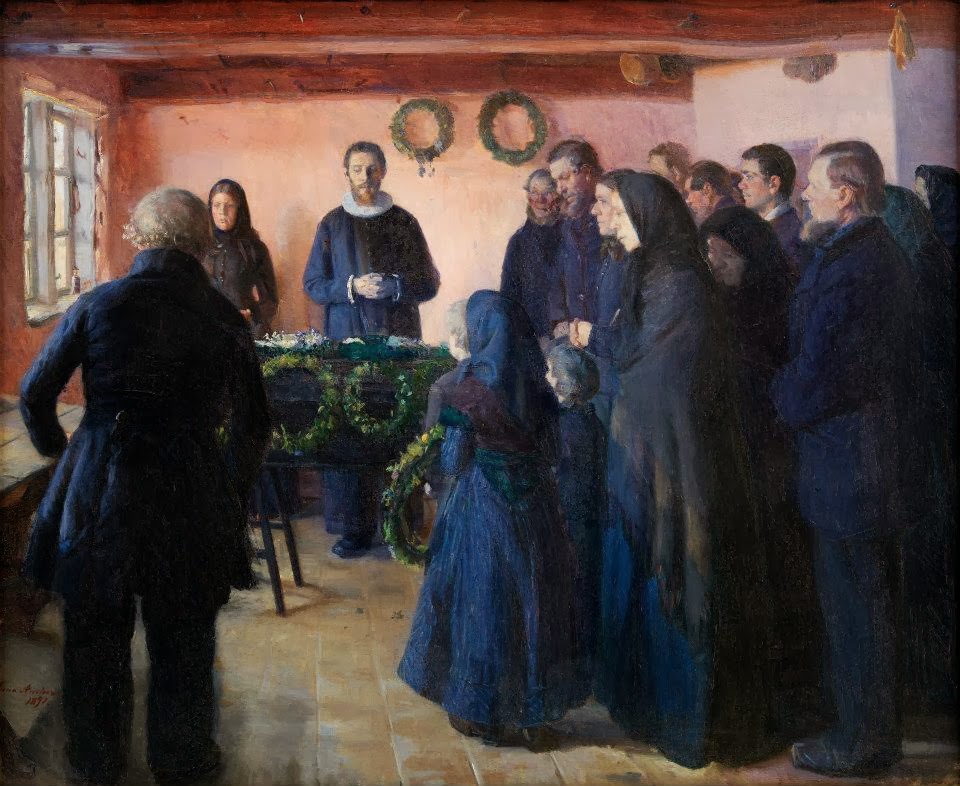
Anne Ancher A Funeral

But here I am, many years later at the Portrait Society Conference, and at my age I don’t paint nearly as well as the twenty twenty-something Finalists (not a typo, at the Portrait Society Awards there are twenty artists whose paintings have been chosen as finalists, and many of them are in their 20s). Their youthful paintings glow like the Rembrandts that I have been memorizing for 20, 30, 40 years.

Lilian Wescott Hale Ziffy in Bed
I believe they do realize how lucky they are to have their immense talent and drive today and not 30 years ago. Today there are Academies and Ateliers that burst with instruction and inspiration for them to launch brilliant careers painting people. And there is a growing art world that embraces realism to welcome them. Seeing what these youthful masters paint and trying to learn, beg, borrow and steal how they have achieved their miracles, well, it pours gasoline on that belly fire of mine.

And now, it would seem, the time for painting people has come again. And, since the young have adopted this passion as their own, there is a strong headwind for a movement. At the Portrait Society I am surrounded by hundreds of kindred spirits and inspiration by the bucketload, but I’m thinking maybe the younger artists don’t actually see me…and unless by some lucky twist of cyber fate they have glanced at one of my facebook posts, they haven’t seen my work either.

Elizabeth Nourse The Little Sister

Nonetheless, the time for me to paint my people has come. I’ve raised my kids, I’ve saved some money, and, health, safety and caring for those I love notwithstanding, I’ve got 20, 30, 40 years ahead of me for this epic journey.

I am the bespectacled and thick lady with the fire in her belly and I am in the process of conquering the world…one painted soul at a time, and I will do so until the end of my time.

And maybe, my inspiring youthful peers at the next Portrait Society Conference will actually see me next year and know that I am on the same passionate people-painting journey they are on, but maybe they will also remember that I’ve been on it since well before there was even a path.

 ……………………………………………………………………………………………

A special thank you to the Art Renewal Center for providing the image for Lady Laura Alma Tedema, to @Linda Crank who compiled so many wonderful images by female painters on her facebook page, and to @Nancy Bea Miller, who writes the Women in the Act of Painting blog from which I lifted the Aremesia Gentileschi painting.


Cecilia Beaux Ethel Page…this painting is just one of the many reasons why we really like Cecilia Beaux!


Written by Judy Takács.

Judy, a painter of people who has gained recognition for her Chicks with Balls project, is also the Chair of New Media Relations for the Cecilia Beaux Forum of the Portrait Society of America. And, no, this is not autobiographical, but it contains bits from her life as well as the lives of the many women artists whom she HAS met over the years.